A running collection of ideas, papers, books, and topics I've been interested in recently.
books i'm currently reading.
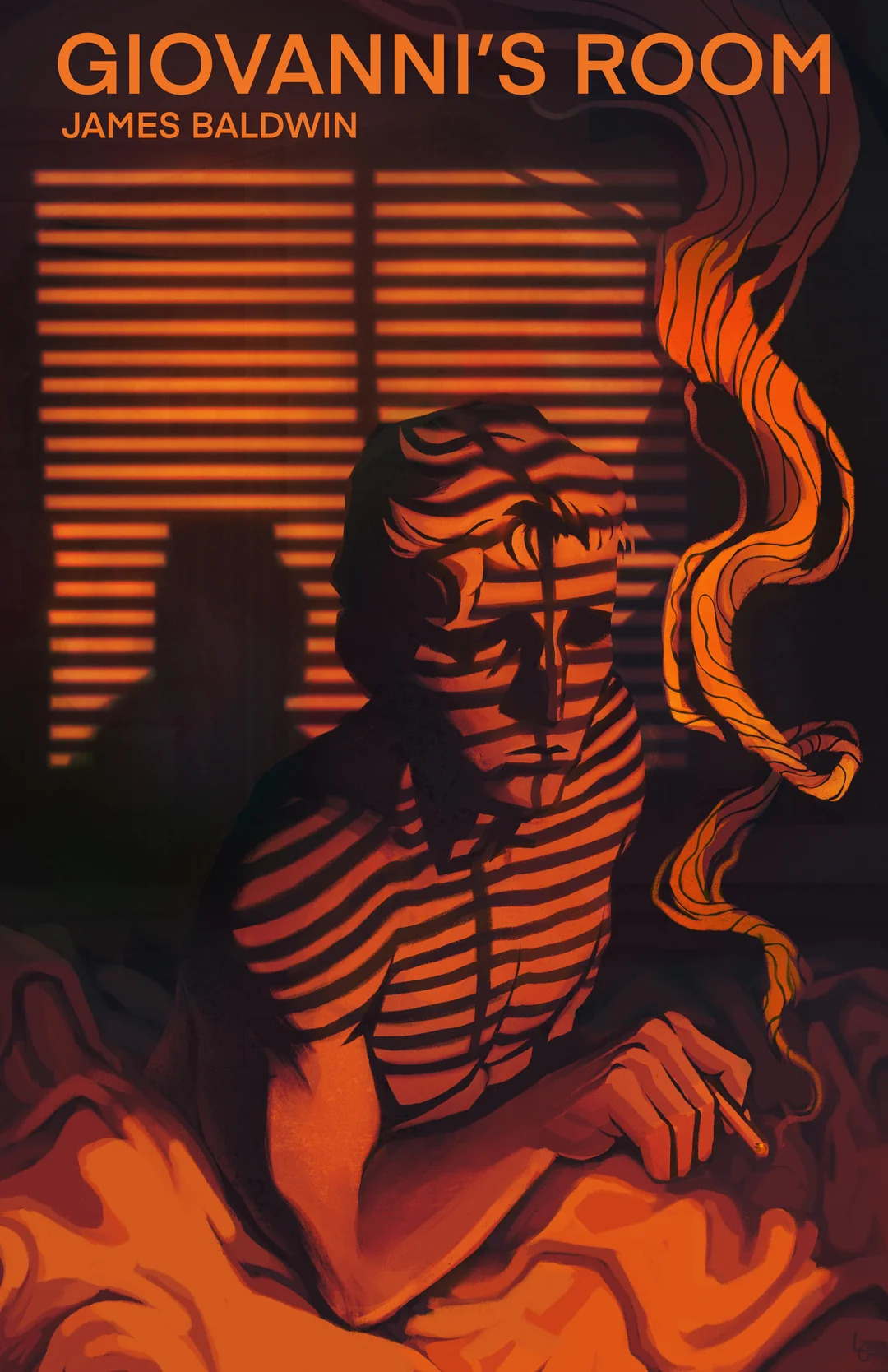
Giovanni's Room
James Baldwin
A novel about love, shame, identity, and what happens when the life you want does not line up neatly with the life you have been taught to want.
This book actually came highly recommended by a stranger I met at a bar on the Lower East Side one Saturday night in New York. I don't even remember how we started talking, or how the conversation somehow got to books, let alone James Baldwin, but he told me I had to read Giovanni's Room. So I picked it up not too long after, and I haven't really been able to put it down since.
It is just really, really well written. I feel like I can see the whole thing playing out in my head while I'm reading it, which I know sounds obvious because that is sort of what books are supposed to do, but some books make the distance between you and the story disappear much more easily than others. The cafés, the apartments, the streets at night, all of it feels very clear to me. Maybe that is partly because it is set in Paris and I can still remember those streets pretty well, so when Baldwin describes someone wandering around the city or sitting somewhere late at night, my mind already has somewhere to place them.
What has interested me more, though, is how much of the book seems to be about the stories people build around themselves. David spends so much time trying to decide what certain feelings mean about him, and almost just as much time trying to convince himself they do not mean anything at all. There is this gap between what he feels, what he is willing to admit he feels, and the person he thinks he is supposed to be, and a lot of the sadness seems to come from watching him live inside that gap. Giovanni ends up caught in it too, which makes the whole thing feel less like a simple tragic love story and more like a story about what self-denial can do to other people.
It is also a surprisingly short book. I expected something this heavy to feel slower, but Baldwin gets into all of this without making the book feel dense or difficult to read. I have been moving through it pretty quickly, although I do keep stopping every few pages, sometimes because of a sentence I want to sit with, and sometimes because, once again, there is French I need to translate.
papers i've found fascinating recently.
On the Shortness of Life
Seneca
A Stoic essay about time and the strange way people move through life without ever really feeling present inside of it. Seneca writes about how people give their time away constantly to anxiety, ambition, obligation, distraction, and other people's expectations, only to later realize how little of it actually felt fully lived. A lot of the essay is really about attention and consciousness and whether we are actually inhabiting our lives while we are living them.
read hereI think this one stays with me because I have a hard time existing in the present without feeling guilty about the future. There is always something else I should be doing, planning for, improving, fixing, or thinking about. Even during good moments, part of my brain is already somewhere else worrying about time running out or whether I am doing enough with the opportunities I have. I think being ambitious and grateful at the same time can sometimes turn into this constant pressure to justify your existence through productivity. This essay reminds me that if every moment only exists as preparation for another moment later on, you eventually realize you never actually allowed yourself to live anything while it was happening.
The Unreasonable Effectiveness of Mathematics in the Natural Sciences
Eugene Wigner
An essay exploring one of the strangest facts about reality: mathematics, something humans invented abstractly in their heads, somehow ends up describing the physical universe with astonishing precision. Wigner reflects on how mathematical systems developed with no practical purpose often later become the exact language needed to explain physics, motion, electricity, probability, computing, and countless other natural phenomena. The essay is partly scientific, but it also feels philosophical and almost unsettling because it raises the question of why reality is understandable at all.
read hereI love this essay because it makes the universe feel simultaneously more rational and more mysterious. The idea that abstract symbols and patterns can predict the behavior of stars, particles, waves, economies, or biological systems feels almost absurd when you really sit with it. Sometimes I'll be studying something deeply theoretical and suddenly realize that the thing I'm looking at is not just a classroom exercise but an actual structure underlying reality itself. There's something deeply beautiful about that to me. It also makes me think a lot about how much of science and technology depends on humanity's ability to notice patterns long before we fully understand why those patterns exist in the first place.
my letterboxd.
Where I log my films and collect my thoughts on them.
visit profileDavid Whyte
Everything is Waiting for You
Your great mistake is to act the drama
as if you were alone. As if life
were a progressive and cunning crime
with no witness to the tiny hidden
transgressions. To feel abandoned is to deny
the intimacy of your surroundings. Surely,
even you, at times, have felt the grand array;
the swelling presence, and the chorus, crowding
out your solo voice. You must note
the way the soap dish enables you,
or the window latch grants you freedom.
Alertness is the hidden discipline of familiarity.
The stairs are your mentor of things
to come, the doors have always been there
to frighten you and invite you,
and the tiny speaker in the phone
is your dream-ladder to divinity.
Put down the weight of your aloneness and ease into the
conversation. The kettle is singing
even as it pours you a drink, the cooking pots
have left their arrogant aloofness and
seen the good in you at last. All the birds
and creatures of the world are unutterably
themselves. Everything is waiting for you.
updated whenever something new grabs me